Nearly Birthday thoughts

It’s nearly 2018, which means it’s nearly time for me to “celebrate” my birthday.

I’ve been thinking about my birthdays in general, and how I feel about them. It’s not the growing old that I have a problem with, it’s the celebration part.

It’s not that I don’t like to celebrate – just that I don’t really enjoy celebrating me.

I’ve never really felt comfortable with being at the centre of attention – or with others putting me there.

For me, there are always other things, bigger things, more important things than me to think about.

Some of them are deeply personal. Others, well, just switch on the news.

It makes it difficult to celebrate when there is so much hurt, loss and despair.

I think it’s easier to celebrate yourself if you are comfortable with yourself. If you struggle with promoting yourself because you don’t think you are worth promoting then you will struggle to celebrate without holding anything back.

The thing is, that if you have been around the church for any amount of time, you are likely to have heard the message “Jesus first, yourself last and others in between”. It’s certainly been my mantra for decades. Sometimes unconsciously, but there nonetheless.

The problem with that mantra though is that if one isn’t careful, one can begin to think that your life and cares are not just less important, but not important at all.

If you are not important, then there is little point in loving yourself.

And that brings an even bigger problem.

I’m called to “love my neighbour as I love myself”. If I can’t love me, My neighbour is going to have a hard time believing I love them.

As Christians one of our primary goals is to love people. The expression of that love may take several forms. It may be simply being available. It may be praying for healing. It may be expressed in a moment, or over decades. But you can be sure that if you really love someone, they will know that they have been loved.

So I guess that I’m saying is it’s ok to love yourself. It’s ok to celebrate you. Maybe, just maybe it will help in our mission to make disciples of all nations.

Hope?

hope 1

2017 has almost gone – and 2018 beckons.

Its been a busy 12 months, almost hectic at times. There have been highs. Friends have been married, others have had children. There have also been lows. Sickness and loss have never been far away.

I have been on planet earth for nearly 45yrs now, long enough to be certain that 2018 holds more of the same for all of us.

Each of us will experience at least one thing that will challenge us. For some of us, this will be something that will rock the very foundation of all that we hold dear and believe.

What will you do when that challenge comes?

Most of us don’t want to contemplate hardship, sickness or death. We are far happier blocking these thoughts out and focusing on the good things. We think that as long as we don’t entertain the thought, the reality won’t transpire, at least not to us or those we love.

My experience is that determining how you are going to react in a crisis during the crisis is a recipe for disaster. If we have thought about how we will react ahead of time, it makes it far more likely that we will indeed react like that when the crisis hits.

Around 2600yrs ago, the Prophet Jeremiah sat in a cave overlooking the Holy city of Jerusalem, as it was destroyed by the Babylonian King Nebuchadnezzar. The city of the Lord lay in ruins, its’ people taken into exile or slain. The treasures of the temple had been taken back to Babylon. Everything he knew and loved was gone. He felt deserted by the only one who mattered – God. He knew that God had promised this if the city did not turn from its wickedness – but as he watched, God felt distant.

There are many reasons that crisis may find us in 2018 – perhaps some of which will be the subject of different blogs (if I’m feeling brave). Reasons for crisis are not the subject of this blog, but how we will react when our world complelty falls apart, like it did for Jeremiah.

In spite of all that was happening  before his eyes, Jeremiah was able to pen the following –

But this I call to mind,

and therefore I have hope

The steadfast love of the LORD never ceases;

his mercies never come to an end;

they are new every morning;

great is your faithfulness.

“The LORD is my portion,” says my soul,

therefore I will hope in him. (Lamentations 3:21-23 emphisis mine)

Jeremiah recalled something he knew of the Lord. He made a choice to recall the love and mercies of the Lord. He ceased to wallow in self pity and dispair. He didn’t focus on the problem – he focused on the Lord – the only one who held any answers in the face of such a problem.

HOPE is such a simple word. In the letter to the Hebrews, we are told that faith is the substance, the assurance of thing hoped for. The things we have faith in should be able to follow through with assurance and substance. Something we can touch and experience. Hope without faith is pointless. Faith with hope gives us assurance.

What are you hoping for in 2018? Whatever we hope for, we can be assured that God will be with us every step of the way. I choose to accept His love. I choose to recall all that He has done in 2017 (and beyond), I choose be believe that He IS GOOD.

Will trouble come my way – almost certainly. Will I allow it to take up residence in my soul – absolutely not.

I pray that whatever 2018 holds for you – whether you are facing it with exitement or with fear – that you will join me in “calling to mind” the love and mercies of the Lord, and face 2108 with renewed hope.


More Christmas musings

What does Christmas mean to you? For many, Christmas means spending time with family, gifts, and time off work. Some remember “the reason for the season” with gusto, others will only give a token nod to the baby who’s birth started the whole thing. 

The birth of babies tend to be an exciting event. I was privileged to be at the birth of both of my children. The miracle of birth, and the awe as I gazed into the faces of my newborn babies was both humbling and terrifying. I knew I had been given an amazing responsibility, and at the same time I was looking at someone who would turn my world upside down.  

I knew that there would be crying (the babies and me), smell (both again??). But most of all I knew that this baby was pretty helpless without my wife and I.

Babies are small and non threatening. They are pretty helpless for the first few years of life. For the most part all they do at first is eat, sleep and cry. Generally speaking, the birth of a baby to a “normal” family doesn’t do much to change world history. 

That’s where the birth of Jesus is different. Whilst Jesus was all that a baby could be (don’t let that peaceful nativity scene fool you) it certainly wasn’t Heaven come to earth with a whimper.  

When Jesus was born, heaven was announcing that the Lion of Judah was on the scene. That Gods plan for humanity had arrived. There was now a way to repair and restore the fracture that happened in the garden of Eden. History was forever changed. 

In the physical realm there may have been a whimper from a baby, but in the spiritual realm there was an Almighty Lion’s roar. 
We read of angels filling the sky and singing praises when the baby was born. 

The angels knew that significance of the birth. 

But there were others who trembled at the birth – because He had been born to destroy everything they were trying to achieve – and they knew that they had already lost. 

The demons knew the significance of the birth. 

My prayer this Christmas time is that as we celebrate a baby’s birth 2000 years ago, we too know the significance of the birth – and hear the Lion’s roar.

Did it really happen like that????

OLYMPUS DIGITAL CAMERA

Christmas.

A time when the church tells the story of the birth of Jesus.

A time when the world hears of a young girl, travelling over difficult terrain, arrives in the dead of night, can’t find a bed and gives birth that very night in a dirty outbuilding surrounded by animals.

Just after birth, the door is opened, and a load of smelly visitors arrive, closely followed by better smelling visitors with better quality gifts.

And we wonder why the world struggles to believe one of the key messages of our story. That God put skin on and came to dwell with us. That that baby would grow, and eventually give His life to give us access to the Father. That we too might live.

We as Christians have a problem.

The world we live in demands a neatly packaged message, with all the key points in one place. So that is what the church has done with the Christmas story. All the key points, Mary and Joseph, unmarried, Mary pregnant, head to Bethlehem, baby born, Angels, visitors and gifts. All presented as the standard nativity. Everything happens within a 24 hr period so we can all get home for hot chocolate and mince pies.

But they also demand a story that makes sense when examined in detail. That is where the church has fallen short. You see, the story, as presented in nativity plays up and down the country has kept to the same basic script, and not really looked at whether it sounds plausible.

Take the stable, manger and inn for example. We all have a mental image of what that looks like. Our brains see these words and we envisage a Travelodge (other hotels are available), a barn on a dirty farm, probably miles from anywhere, and a wooden box, filled with straw. The church has conveniently concocted lessons from each of these, but the story has never quite sat comfortably with me.

The bible actually says that Mary & Joseph went to Bethlehem, and “while they were there, the time came for her to give birth”. Not on the night they arrived, but some time afterward. Where were they staying? Had they had a booking at the local motel, but had run out of money? Perhaps they had more distinguished guests that needed the room?

We are told that Joseph was a descendant of King David. That alone would have afforded him access to pretty much any home in the town. Match that with a pregnant fiancée, and there isn’t a community in the world that would not have welcomed them into their home.  If there really wasn’t room in a house, there would have been plenty of time for Mary & Joseph to travel the short distance to Mary’s relatives Elizabeth and Zechariah. They lived nearby (Mary had visited a few months earlier.)

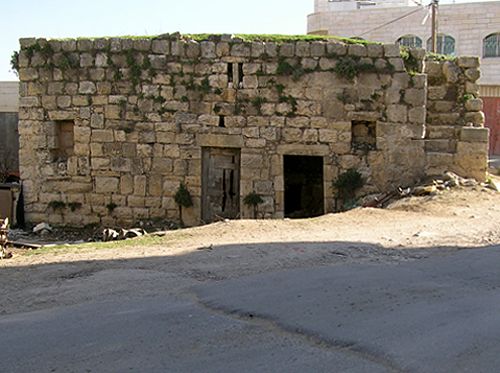
Houses in Bethlehem at the time of Jesus would have consisted of two rooms. One, the family room, where the entire family lived. They would have eaten, slept and entertained in this room. An attached room would have been at a slightly lower level to house the family animals. The animals would have been brought in at night to keep them safe. Perhaps there would have been small hollows, filled with straw between the two rooms, so the cows could feed at night. Some houses would have had an additional room added – a guest room. The word translated “inn” can also mean guest room.

How about this for a paraphrase of events.

Mary and Joseph headed to Bethlehem, because there was to be a census, and Joseph was from Bethlehem. Although Mary was pregnant, there was plenty of time to make the journey and get settled. They stayed with one of Josephs relatives. Lots of people had returned for the census, so all the homes were a bit tight for space. Some people who had arrived early had taken up residence in the guest room, so Mary and Joseph had to squeeze in with the rest of the family.

While they were till there, Mary gave birth, surrounded by friends and family. She would have liked to have been in the guest room, but it was full, and moving the occupants out in the middle of the night wasn’t really practical. Conveniently, there was a straw filled hollow at the end of the room, and the baby was placed there to sleep.

Shepherds, who were the lowest of the low in Jewish society were watching their sheep that night. Suddenly and Angel appeared and told them not to be afraid. They thought it was a reasonable emotion, but listened to what the Angel said, and headed down to Bethlehem and found things, just as the Angel had said. They were aware of who they had found. They knew He was the Christ. And they worshipped, and then went back to their fields. Had they felt that the Saviour of the world was living in an inappropriate place, or at the very least less salubrious than their own homes, do you not think they would have offered to rehome the new family?

A couple of years later, astrologers from Arabia came looking for the new King. They brought gifts fit for a King, for they knew the importance of this birth. They had gone to the Palace in Jerusalem initially. They found a King, but not a young child. They kept their gifts, knowing that there was another, worthy recipient.

We don’t have to embellish the story to make it mysterious. We still find Angels, virgin births, and dreams. Perhaps if we start telling it like it was, rather than how “we have always told it” more people would see the truth of the story, and would want to meet the Jesus that came to earth to dwell with us, to reconcile us to the Father, and who wants to give hope and purpose to our lives.

(I unashamedly used Kenneth Bailey “Jesus Through Middle Eastern Eyes, cultural studies in the gospels” as a source for this blog. Any difference in interpretation to his original work as I paraphrased is entirely my own)


May we never stop imagining. 

There are a lot of Christmas themed posts across social media these days. They seem to be appearing earlier and earlier, but perhaps I’m just getting older and less tolerant.Today I read an article entitled “Should parents let their children believe in Santa Claus?”
I must confess, I’ve been avoiding reading it for a few days, because I was pretty sure it was going to annoy me. I wasn’t disappointed. 

The article itself was pretty much what I expected. Basically, I was told that I was a terrible parent because I’ve done nothing to stop my children from believing in someone who doesn’t actually exist. (except for the fact that he does – he just doesn’t live at the North Pole, he lives in Loose)

I wonder if those that have been getting very het up (some of the comments are priceless) at the idea that children believing in Santa will mess them up for life will also prevent their children having imaginary friends, or watching films where something magical happens. In the Lion, the Witch and the Wardrobe there are talking beavers and Lions and ‘animals’ that don’t exist. I’m pretty sure that the people who don’t agree with Santa would have no problem with letting their children immerse themselves in this fantasy. Or allowing them to read books where a rabbit and a fox are the best of friends, or giants give their scarves to giraffes with a cold neck.

 My son plays with Lego, (like normal 8-year olds) and talks to the pieces, describes conversations and adventures with them (again, like normal 8-olds). Am I to stop him, tell him to stop believing the pieces of plastic are real?

I get the fact that we need to tell our kids the “real meaning of Christmas.” We try to present the truth in an accessible way for our kids. We look for a way each year to remind them of the Christmas story. Sometimes this is through a “Jesse tree”, sometimes through doing a “Christmas story advent calendar.”

Truth is important – I don’t dispute that – but the suggestion that believing in Santa Claus will confuse children is later life is, in my opinion ridiculous. 

Perhaps if we were more focused on our  relationship with the Jesus whose birth is celebrated at Christmas there would be less of a need to get tied up in things that probably don’t matter.  Some people (and many of them commented on the original article) seem to have a theologically, rational and logical relationship with a set of rules, which they hope will get them a ticket out of here and into heaven, but they are missing a relationship with the Jesus who wants us to come to him as little children. Innocent, trusting, willing to dream huge dreams, take huge risks and see amazing things happen.  

As adults we understand more than our children do. But I think there is still a place for wonder, and imagination. If we were honest, I don’t think any of us can fully understand how the God of the Universe appeared on earth as a baby. Or how choirs of the heavenly host appeared to shepherds watching their flocks, without disturbing the rest of Bethlehem. We must use our imagination.

I don’t believe that God wants us merely to think about things. The Greeks were great at thinking, and discussing things. And the Greeks were also great at tying themselves up in knots and not actually believing anything concrete.

If I am to see things “beyond that which I can ask OR imagine” I’m going to make sure I ask AND imagine some pretty big things. If I am imagining, isn’t that the same as believing something that isn’t there.

Quite apart from the fact that I don’t believe we can “stop” or “allow” our kids to believe anything they don’t want to, I’m pretty convinced we should be promoting the opposite – get them to dream big. Tell them of a God who loves them and wants the best for them. Who has a plan for them. And that plan is huge!